
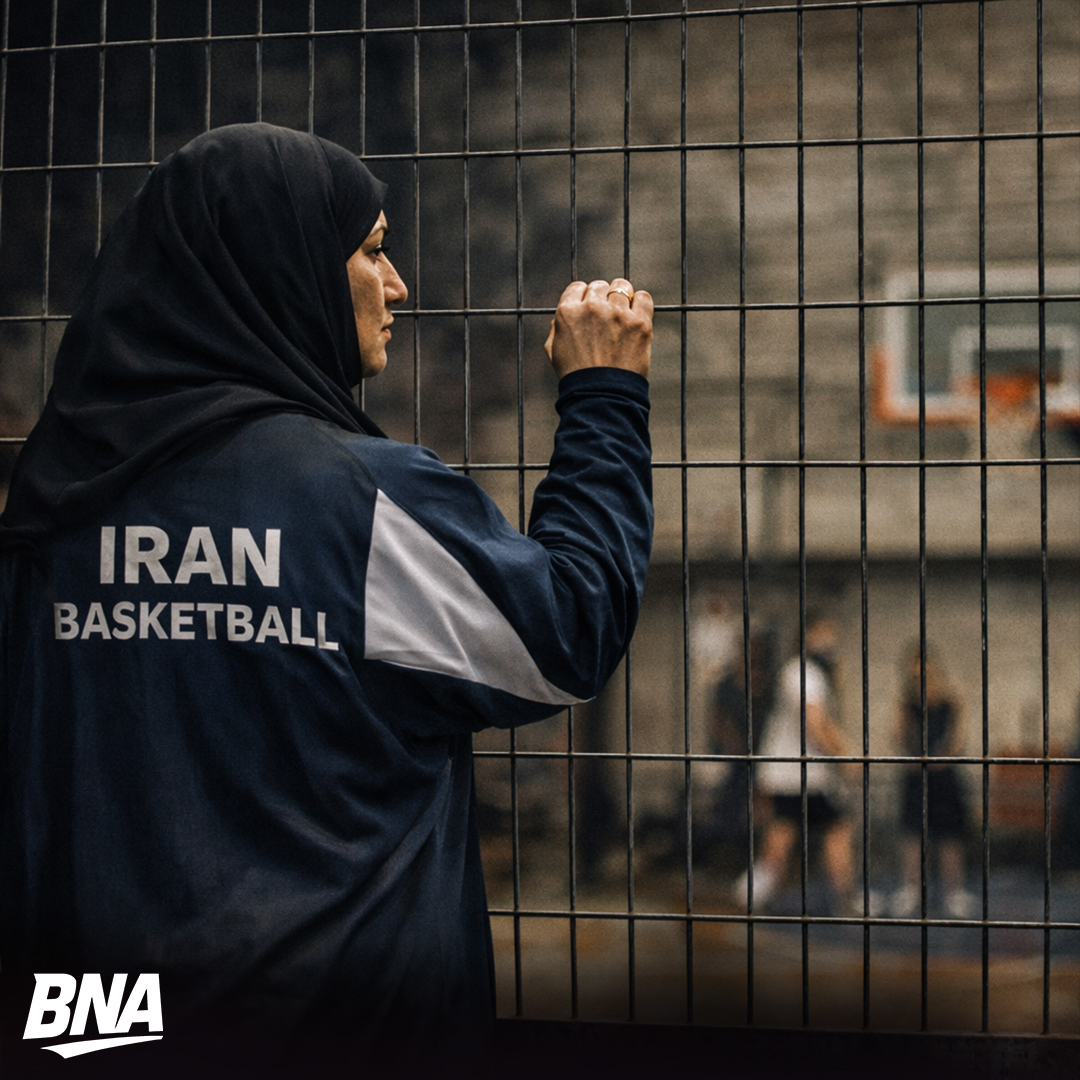
Iranian Women’s Basketball and the Ceiling No Cares About
Iranian Women’s Basketball and the Limits No One Talks About
Basketball in Iran is not short on talent. From school gyms to national competitions, the sport has produced skilled players and respected coaches, particularly on the men’s side, where clearer pathways and stronger backing have helped maintain Iran’s presence on the Asian stage.
The dividing line, according to those working within the system, sits off the court.
Zahra, an Iranian women’s basketball coach with experience across development and international programs, says the gap between men’s and women’s basketball is less about ability and more about governance, planning, and how much freedom the game is given to grow.
“The difference is not talent,” Zahra told Basketball News Australia. “It’s how decisions are made, and how much freedom the sport has to develop.”
Two Programs, Unequal Footing
Men’s basketball in Iran generally operates with more continuity. League schedules are more reliable, facilities are stronger, contracts are better supported, and development pathways from junior levels to elite competition are clearer.
Women’s basketball, while organised through a domestic league, faces ongoing uncertainty. Investment is smaller, planning is inconsistent, and the structure around youth development is often weaker.
“In terms of budget, facilities, salaries and logistics, the difference is clear,” Zahra said. “But what really widens that gap is governance and long-term planning. When strategic control is centralised and shaped by non-sport factors, women’s programs are rarely treated as a priority.”
Zahra said the consequences show up everywhere, from how competitions are scheduled to how programs are resourced, and how consistently young players are supported.
Talent Without an Ecosystem
Despite the structural challenges, Zahra is emphatic that Iran’s women’s talent pool is deep.
“I started basketball when I was nine,” she said. “I played in the national mini-basketball championships in Zanjan and won third place in my first national competition. From that moment, basketball never left my life. It became part of who I am.”
She believes the issue is not talent, but the ecosystem around it. Limited visibility, restricted public access, and inconsistent coverage make it difficult for women’s basketball to build a stable fan base, attract sponsors, or develop sustained pathways.
“When women’s basketball is not culturally normalised or publicly visible, it lacks the ecosystem needed to grow,” she said. “Fans, media coverage, role models and commercial support all matter. Without them, talent is harder to discover, develop and sustain.”
Zahra said this also makes it difficult to compare the men’s and women’s games in a meaningful way, because the environments are not equal.
How Governance Shapes Everyday Sport
Zahra said the influence of politics and ideology is not just abstract, but something that filters into everyday sporting decisions.
“In Iran, politics and ideology do not remain at a macro level,” she said. “They directly enter the smallest layers of sporting decisions.”
She pointed to cases where competition decisions are made for reasons unrelated to basketball, impacting athletes and coaches at every level.
Beyond matches and schedules, she said, professional opportunities can depend on alignment with expectations outside sport, including dress codes and lifestyle standards.
“If a coach is not aligned with the official political views, ideological framework, dress codes, or lifestyle expectations, their opportunities are severely limited,” she said. “This doesn’t only apply to national teams. Even working in schools or private academies can become impossible.”
The result, she argues, is a system where career progression can depend less on knowledge and results, and more on how closely someone is seen to “fit”.
The “Safe Option” Problem
Zahra described a pattern she believes holds back long-term development: decision-makers favouring what she called “safe options”.
“A safe option is usually someone who is politically quiet, non-critical, and not perceived as a threat,” she said. “In many cases, they are not the most qualified, but the most controllable.”
She said this often leads to underqualified leadership in key roles, while experienced specialists are sidelined, damaging talent pathways and professional standards.
“The contradiction is painful,” Zahra said. “People with political or institutional status, but little technical competence, can be appointed to manage teams or federations. That seriously damages real talent development and the long-term quality of sport.”
Women Coaching in a Male-Dominated Structure
Zahra said women coaches face an additional layer of difficulty within that system, particularly when it comes to authority and professional respect.
“Earning authority and trust as a woman coach is significantly more difficult than for male colleagues,” she said. “In many environments, being a woman is seen not as a strength, but as a weakness.”
She described an everyday reality of harsh judgment and professional disregard, with women often expected to remain silent while men are given more latitude to lead, fail, and recover.
Zahra said she built her authority through knowledge, consistency, and results, and by setting firm ethical boundaries.
“The most meaningful moments are when gender does not matter,” she said. “When players and clubs trust me as a coach, not as a ‘female coach’. That respect, based on knowledge and results, is powerful.”
Coaching Through Science
Zahra’s coaching philosophy is shaped by her background in sports science and biomechanics, which she says allows her to go beyond instruction and explain movement with precision.
“Biomechanics helps me improve shooting technique and movement efficiency, reduce injury risk, correct alignment and footwork, and develop players in a safer and more scientific way,” she said.
“Instead of only saying ‘do it better’, I can explain how the body should move and why. Player development becomes faster, smarter and more sustainable.”
Working Abroad and Changing Perspective
Zahra has coached across Iran, Qatar, and Oman, and said working overseas reshaped her personally and professionally.
“Working in different countries is like attending a real-life university,” she said. “You learn cultures, working styles, how to build relationships, and how to adapt quickly because contracts start and end and life changes fast.”
She said international experience also challenged common misconceptions.
“In many places, I first have to explain that women in Iran do play sports seriously, and that there is a professional women’s basketball league, despite heavy limitations,” she said. “And our language is Persian, not Arabic.”
She added that helping Iranian players secure overseas opportunities, including bringing some into her teams as imports, remains one of her proudest achievements.
Barriers Beyond Basketball
Outside the court, Zahra said unequal pay and visa restrictions have shaped her career opportunities.
“Unequal salaries between male and female coaches, passport limitations and work visa issues,” she said. “Several times I lost opportunities because countries preferred not to enter the visa process for an Iranian passport.”
Still, she views those setbacks through a lens of resilience.
“I believe obstacles either break you or make you stronger,” she said. “They made me stronger.”
What Needs to Change
For Iranian women’s basketball to genuinely grow and compete internationally alongside the men’s program, Zahra believes reform must begin with structure.
She pointed to transparent governance, professional management, long-term youth development plans, and properly implemented international standards as essential foundations.
“Iranian basketball, especially women’s basketball, can only improve with clear, professional governance,” she said. “Long-term plans for youth and leagues, and equal institutional respect for women’s programs.”
“Sport in Iran will always operate within national laws,” she added. “But without fair rules, professional management and structural reform, women’s basketball cannot realistically grow alongside the men’s program.”
What Zahra’s Story Leaves Behind
Zahra’s account is a reminder that basketball development is shaped not only by talent or coaching knowledge, but by the structures that sit above the sport. Pathways, league stability, youth investment, and visibility can either lift a game or quietly limit it.
Iran’s women’s basketball, she says, continues to produce players and coaches capable of competing at a far higher level. Unlocking that potential will depend on consistent planning, professional governance, and long-term intent, rather than what happens in training sessions alone.
For now, Zahra’s career continues overseas, while remaining deeply tied to the game that shaped her.
Editor’s Note:
The coach featured in this report is referred to by a pseudonym to protect her safety and professional position. Some identifying details have been withheld. Her comments are reported faithfully and reflect her direct experiences within Iranian basketball.